
SPACE & DEFENSE Tech and Security News spotlights Dr. Alison Brown’s keynote on PNT as a Service (PNTaaS) from the PNT 2026 Conference in Royal Randwick Racecourse, Sydney NSW. In interview with Australia Space TV, she explores the critical role of resilient positioning, navigation, and timing (PNT) across space, cyber, and logistics sectors, highlighting the future of PNTaaS. PNT as a Service - YouTube

Dr Alison Brown, President and Chief Executive Officer of NAVSYS Corporation and CEO of PNTaaS Ltd. Dr Brown grew up in Edinburgh Scotland and has a PhD in Mechanics, Aerospace, and Nuclear Engineering from UCLA, an MS in Aeronautics and Astronautics from MIT, and an MA and BA in Engineering from Cambridge University.
Existing and planned space-based PNT solutions are all operating in L-band. This includes the GNSS and SBAS constellations, as well as commercial LEO PNT solutions such as Iridium and Xona. All of these L-band solutions are vulnerable to denial from the widespread high-power jamming that is now prevalent in some regions. While the planned ESA Celeste LEO-PNT demonstrator satellites will also broadcast in L-band, and the planned Trustpoint LEO-PNT constellation will work at C-band, there are only limited frequency allocations available for PNT making these future dedicated PNT solutions also susceptible to jamming.
There are multiple satellite constellations already deployed with existing spectrum allocations at C, Ku and Ka-band which combined have over 10 GHz of frequency allocations, much more than is available at L-band for PNT. These broadcasts include hundreds of media and SATCOM satellites operating at GEO, thousands of SATCOM satellites from multiple LEO constellations and also many MEO SATCOM services as well.
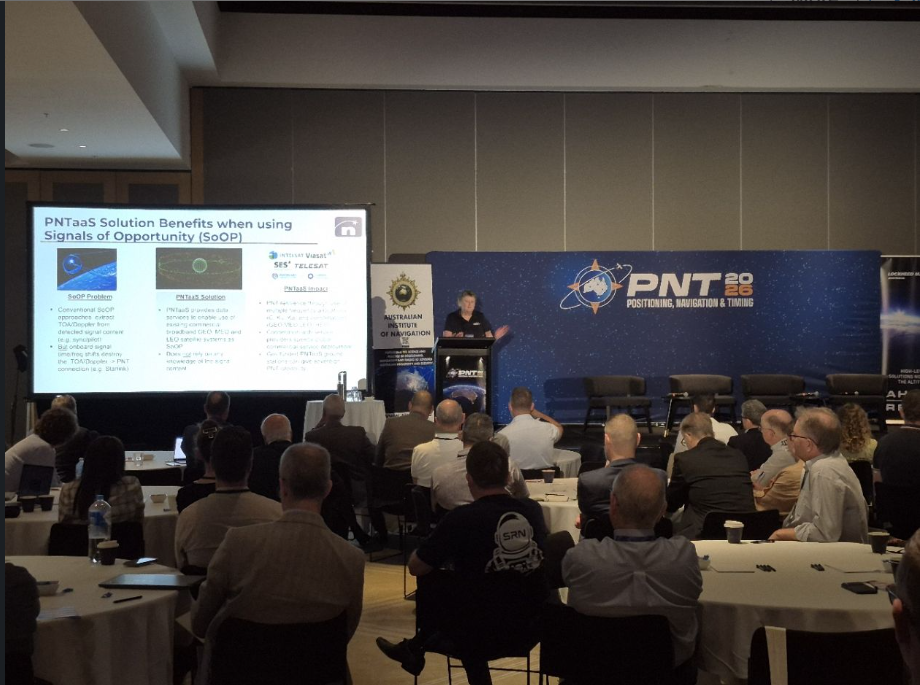
In her presentation, Dr Brown detailed the PNT as a Service (PNTaaS) architecture which allows any broadband commercial satellite signals to be used for PNT. PNTaaS ground stations are used to deliver data services that allow extraction of time of arrival data from these existing SATCOM signals without requiring any knowledge of their signal structure. By also publishing precise timing corrections and orbit location data, precision PNT can be delivered providing a global backup solution to GNSS operating with signals in C, Ku and Ka band.